
• Texas Real Estate Commission Consumer Protection Notice
  • Texas Real Estate Information About Brokerage Services

Navy Fellas Realty Group

Real Estate, Residential sales and purchase

  • Home
  • About Us
    • About James
    • About Ashley
    • About Our Team
    • Accessibility Statement
  • Property Search
  • Resources
    • Home Buyer Tips
    • Home Seller Tips
  • Video Walkthroughs
    • Saratoga Homes (Plantation Lakes -Katy, Tx.)
    • David Weekly Home (Towne Lake)
    • Taylor Morrison Home (Alder Trails)
    • Ashton Woods (Towne Lake)
  • Blog
  • Contact

How to Determine the Right Mortgage for You: The Pros and Cons of Each Type

April 21, 2016 by James Scott

How to Determine the Right Mortgage for You: The Pros and Cons of Each TypeFinding the right mortgage can be a struggle. There’s a wide array of mortgage products on the market, and you don’t always need to get a mortgage through your bank – and with so many options, it’s hard to know which one is your best bet.

Your ideal mortgage will depend on your own individual financial situation, but when you understand how different kinds of mortgages work, it’s easier to choose the right one. Here’s what you need to know about mortgage types.

Fixed-Rate Mortgages: Home Financing At A Guaranteed Rate

A fixed-rate mortgage is exactly what it sounds like: A mortgage with a fixed interest rate. With a fixed-rate mortgage, your interest rate is locked for the life of the mortgage loan and cannot change.

When interest rates are at historical lows, a fixed-rate mortgage is an ideal financing option. By purchasing a fixed-rate mortgage at a low interest rate, buyers lock in low payments and are protected from sudden rate increases. However, fixed-rate mortgages are more difficult to qualify for when interest rates are high.

Variable-Rate Mortgages: Lower Rates And Larger Loans

A variable-rate mortgage is a mortgage wherein the interest rate fluctuates over time. Typically, the interest rate will stay constant during a set period of time near the start of the mortgage, and then start to vary. These mortgage rates rise and fall in line with the prime lending rate.

The major advantage of a variable-rate mortgage is that its lower initial rates and payments allow buyers to qualify for larger homes. Buyers can also take advantage of falling interest rates without having to refinance. However, variable-rate mortgages can quickly become expensive if interest rates see a sharp rise – and while some mortgages put caps on the maximum annual increase, these caps don’t usually apply to the first rate change.

Interest-Only Jumbo Mortgages: Flexible Terms For Wealthy Buyers

An interest-only jumbo mortgage is a specialty mortgage designed specifically for wealthy buyers purchasing luxury homes. The major advantage of this kind of mortgage is that borrowers can make interest-only payments for the first 10 years of the loan. However, interest-only mortgages are typically only available to well-heeled buyers who can afford a hefty down payment and prove that they have large cash reserves.

Finding the right mortgage can be a challenge. That’s why it helps to consult with a mortgage advisor who understands the terms and rates, and can negotiate a great deal for you. For more information, contact your trusted real estate professional.

Filed Under: Home Mortgage Tips Tagged With: Home Mortgage Tips, Mortgage Tips, Mortgage Types

How the Truth in Lending Act Protects You When You Take Out a Mortgage

April 6, 2016 by James Scott

How the Truth in Lending Act Protects You When You Take Out a MortgageIf you’re planning to get a mortgage, it’s critical that you know your rights under the law. The Truth in Lending Act (TILA) is a piece of federal legislation that governs how mortgage lenders can and cannot operate their businesses.
So how does the Truth in Lending Act protect you, and what are your rights under this legislation? Here’s what you need to know.

Your Lender Must Give You A Timely Loan Estimate

A Loan Estimate (previously known as a Good Faith Estimate) is a document your lender provides you that details information about what kind of a mortgage you’ve applied for. Your Loan Estimate includes terms such as your estimated monthly payment, your estimated interest rate, and whether or not your mortgage balance is able to rise even if you make payments.

Under the Truth in Lending Act, your lender is obligated to give you a good-faith Loan Estimate within three days of when you apply for your mortgage. If your lender fails to provide your Loan Estimate within three days or fails to fix reported errors within 60 days, you can sue for damages and report the lender to the federal government.

Your Lender Must Notify You Of Rate Changes

The Truth in Lending Act states that your mortgage lender is required to give you an annual percentage rate estimate within 1/8 of one percent of government guidelines. Your lender must use the government-approved mathematical formula to provide your rate estimate.

If your estimated rate may be subject to change, your lender is obligated to disclose the first possible change you’ll see to your interest rate, and the maximum degree to which it may change. Your lender is also required to disclose the maximum possible changes for subsequent rate adjustments.

There Are Strict Rules About How And When Lenders Can Charge Late Fees

If your lender typically administers fees for late payments, TILA will specify that your lender must notify you – in advance – the date on which a late fee will be imposed and how much the late fee will be. TILA states that no late fee can exceed 4 percent of the amount past due, and a payment is only considered late if it is 15 or more days past due (or 30 or more days past due if you prepaid your interest). Your lender also cannot charge you a late fee on top of a late fee.

TILA is a powerful consumer protection law that gives would-be homeowners a great deal of power. By knowing your rights under TILA, you’ll be able to confidently negotiate with lenders and avoid any unnecessary problems. Contact your real estate professional to learn more.

Filed Under: Home Buyer Tips Tagged With: Home Buyer Tips, Mortgage Tips, The Truth In Lending Act

Video: What Do Lenders Have To Tell You About Your Real Estate Loan?

December 18, 2015 by James Scott

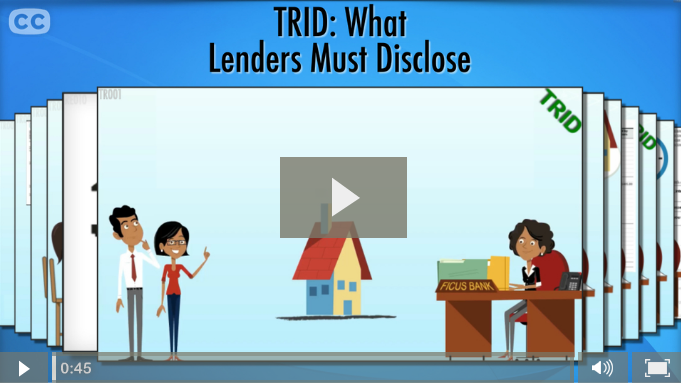
What Do Lenders Have To Tell You About Your Real Estate Loan?

Federal “disclosure” forms define the information that creditor businesses MUST provide to consumers applying for real estate loans.

As of Oct 1, 2015 lenders must provide TWO New “TRID” disclosure forms. for the most common kinds of real estate loans First, the Loan Estimate, which covers the key features, costs and risks of a mortgage loan.

For an approved loan this must be returned to the consumer within 3 business days of loan application. If the loan goes forward, the Closing Disclosure form, covering key transaction costs, must be delivered at least 3 business days before loan consummation.

What Do Lenders Have To Tell You About Your Real Estate Loan

Filed Under: Mortgage Guidelines Tagged With: Mortgage Guidelines, Mortgage Tips, TRID, Video

  • « Previous Page
  • 1
  • 2

Connect with Me!

SEARCH FOR HOMES 
What’s my home worth? 

Return to top of page

Copyright © 2026 Navy Fellas Realty Group. All rights reserved.   Log In